
Some careers are built brick by brick, quite literally. Lalit Kumar Jain’s path through Pune’s real estate industry spans more than two decades, marked by steady growth, hands-on learning, industry leadership, and a recurring focus on transparency in a sector not always known for it. Rather than one dramatic breakthrough moment, his story reads more like a series of consistent, compounding decisions — the kind that, over twenty-plus years, add up to a recognizable legacy. Here’s a closer look at the milestones that shaped that journey.
The Early Groundwork
Lalit Kumar Jain’s entry into real estate began early — at the age of 17, when he took up a role as a supervisor at a Pune-based construction company. It’s an unusual starting point for someone who would go on to lead a major developer and later head a national industry body, but it’s also the part of his story that gets repeated most often, and for good reason: it shaped how he approached the business later on.
Working as a supervisor meant learning the trade from the ground up — quite literally standing on construction sites, understanding material quality, tracking project timelines, and seeing firsthand what separates a well-run site from a poorly managed one. These weren’t lessons absorbed in a classroom or a boardroom; they were learned through direct, daily exposure to how buildings actually get built. He later paired this practical grounding with formal education, completing a degree in Civil Engineering, which gave him the technical vocabulary to match the instincts he’d already developed on-site.
This combination — real-world experience first, formal training alongside or after — is fairly distinct from the more conventional career path of an engineering degree followed by an entry-level corporate role. It’s also a detail that recurs across nearly every account of his career, suggesting it became something of a personal narrative anchor: the idea that credibility in construction has to be earned at ground level before it can be exercised from the top.
1990: Kumar Builders Takes Shape
In 1990, Lalit Kumar Jain established Kumar Builders, building on experience gained earlier at his family’s business, Kumar and Co. This wasn’t a cold start — by this point, he’d already spent years learning the practical and managerial sides of the business. What 1990 represents is the formal consolidation of that experience into a company bearing his own direction and standards.
The company’s guiding principle — “We Build Trust” — became something of a working philosophy rather than just a tagline. In an industry where buyer skepticism is common and project delays are frequent, positioning a company around trust was as much a market differentiator as a values statement. Over time, this phrase would become closely associated with the brand itself, repeated in nearly every piece of company literature and profile written about Jain since.
2001–2005: The "Golden Era"
This five-year stretch is often referred to, within company materials, as Kumar Builders’ “Golden Era.” During this period, the company became known for consistent, on-time project delivery and a string of profitable partnerships — two things that, in real estate, tend to reinforce each other. Timely delivery builds buyer confidence, buyer confidence supports sales velocity, and sales velocity funds the next phase of development. It’s a fairly standard growth loop, but one that not every developer manages to sustain, and the “Golden Era” framing suggests this was the period where Kumar Builders’ execution model proved itself at scale.
It was also during this stretch that the company’s reputation began extending beyond residential complexes into a broader portfolio — IT buildings, retail spaces, and integrated communities — diversifying the business beyond a single product type.
2003: Managing Director of KUL
On February 3, 2003, Lalit Kumar Jain became Managing Director of Kumar Urban Development Limited (KUL), formalizing his leadership over what had grown into a sizeable real estate operation. Under this structure, the company would go on to deliver over 100 projects and more than 14,000 residential units across Pune — a scale that placed it among the more established names in the city’s development landscape.
The MD title in 2003 marks a useful dividing line in his career timeline: everything before it is the buildup — learning, founding, early growth — and everything after reflects the running of an established, scaled organization with a defined leadership structure.
Industry Leadership: CREDAI
Beyond his own company, Jain played a significant role in organizing Pune’s broader developer community, and this is arguably where his public profile extends furthest beyond Kumar Builders itself.
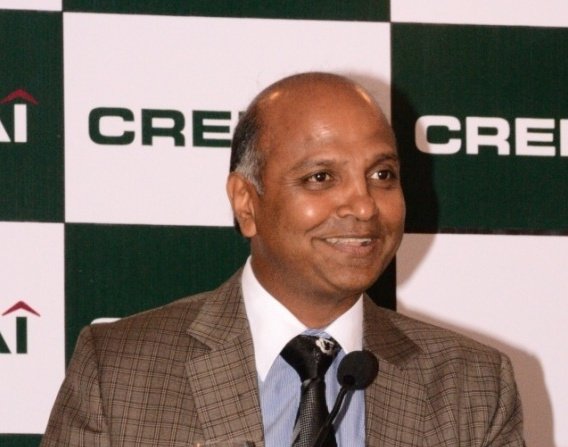
He was among the founding members of CREDAI (Confederation of Real Estate Developers’ Associations of India) when it was established in 1999, at a time when the industry lacked a unified national voice. He later served as Vice President of CREDAI West, helping build out the organization’s regional presence, before being elected National President of CREDAI in 2011 — one of the most senior leadership positions available within the Indian real estate industry’s self-regulatory structure.
In that role, he championed an initiative called “Mission Transparency,” aimed at making real estate transactions clearer, more standardized, and more accountable to homebuyers. This theme — transparency as both a company value and an industry-wide cause — is one of the more consistent threads running through his public-facing work, appearing in his individual company practices as well as his national-level advocacy.
He also served as one of the youngest Secretaries, and later President, of the Promoters and Builders Association of Pune (PBAP) — an early indicator of a pattern that would repeat throughout his career: taking on industry leadership roles in parallel with his core business responsibilities, rather than after stepping back from them.
Recognition Along the Way
Jain’s contributions earned him several awards through the mid-to-late 2000s. These included the Pune Ratna Award (2006) for contributions to the social and business fields, the Nirman Bharti Rashtriya Samman (2006), recognizing contributions to economic and social development, and the Man of the Year title from Accommodation Times (2008). Taken together, these awards reflect a period where his profile was being recognized not just within the construction industry narrowly, but in broader business and civic circles in Pune.
The "Green Man of Pune"
A recurring thread throughout his career has been an early focus on eco-friendly construction practices, which earned him the nickname “Green Man of Pune.” This is worth noting because the timing matters: sustainability-focused construction wasn’t a mainstream expectation in Indian real estate during the years this nickname took hold. Incorporating eco-friendly design and practices ahead of regulatory or market pressure to do so suggests this was a genuine operating preference rather than a later rebrand to fit changing buyer expectations.
Looking Back, Looking Ahead
From a 17-year-old supervisor learning the trade on a construction site, to founder of a company built around trust, to a national-level industry leader shaping conversations around transparency — Lalit Kumar Jain’s two-decade arc reflects a fairly consistent thread: incremental growth backed by hands-on credibility, rather than any single dramatic turning point.
In an industry where reputations can be made — or unmade — by a single high-profile project, that kind of steady, compounding track record is itself the milestone worth noting. Two decades in, the throughline of his story isn’t a single landmark deal or headline-grabbing launch; it’s the accumulation of roles, responsibilities, and recognition built one stage at a time.